
Tag: mental-health

  • I Thought I Was Burned Out | The Truth About Stress, Exhaustion, and Midlife

    I Thought I Was Burned Out | The Truth About Stress, Exhaustion, and Midlife

    Somewhere in my early thirties, I began to feel it.

    Not all at once. Not dramatically. Just… here and there.

    An aggravated hip after a long shift. A left shoulder that would ache for days because I “slept wrong.” A harder time getting back into my routine after a vacation. My bounce-back started to feel less like a bounce and more like a slow roll.

    At the same time my body was whispering, my mind started getting louder.

    On paper, everything was right.

    Marriage. Home. Kids. Career.
    All the boxes checked.

    Everything was exactly as it should be.

    So why did I feel… off?

    Why was I so tired all the time?
    Why was I gaining weight in a way that didn’t make sense?
    Why was I quietly Googling things like “How to be a happy woman?”

    I can laugh about that now. But at the time, it didn’t feel funny. It felt heavy. Confusing. A little scary, if I’m honest.

    I was working around 60 hours a week. Salary, not hourly. There was no clocking out, just carrying it all home with me. No matter how much I gave, there was always more to do.

    And without realizing it, I stayed in that cycle longer than I should have.

    Somewhere in the middle of taking care of everything and everyone else, I stopped checking in with myself.

    And slowly, almost without noticing, I became stretched thin in every direction.

    As a wife.
    As a mother.
    As a woman who used to know herself.

    Was I burned out?

    Now, I can say yes.

    Back then, I wouldn’t have dared.

    Because saying I was burned out felt like admitting something had gone wrong. I had worked for that job. I had earned it. I had been mentored, trained, prepared. That position was supposed to be the reward.

    So how could I say,
    “I worked so hard to get here… and now I don’t want it anymore”?

    I couldn’t.

    So instead, I kept going.


    What We Call “Burnout”

    Eventually, I started hearing the word more.

    Burnout.

    It’s a term we throw around often, but it actually has a very specific meaning. The World Health Organization defines burnout as a syndrome resulting from chronic workplace stress that has not been successfully managed. It is characterized by exhaustion, detachment, and a reduced sense of effectiveness (World Health Organization, 2019).

    And it’s not rare.

    Burnout and stress are at all-time highs across professions, with the majority of adults reporting work-related stress and many experiencing emotional exhaustion and physical fatigue (American Psychological Association, 2022).

    So if you’ve felt this… you’re not alone.

    Not even close.


    But Here’s What No One Told Me

    Burnout isn’t just in your head.

    It’s not just emotional.

    It’s not just about being tired or needing a vacation.

    Chronic stress actually changes the way your body functions.

    When we are under prolonged stress, the body activates the hypothalamic–pituitary–adrenal (HPA) axis, releasing stress hormones like cortisol. Over time, this system can become dysregulated rather than returning to baseline (Ciobanu et al., 2021; ).

    And when that happens, the effects show up everywhere:

    • Energy levels
    • Sleep patterns
    • Weight regulation
    • Mood
    • Even immune function

    Burnout doesn’t just feel physical.

    It becomes physical.


    So Maybe It Was Burnout…

    Looking back, burnout was definitely part of my story.

    The long hours.
    The constant demand.
    The pressure to keep showing up at a high level no matter what.

    That was real.

    But something else was happening too.

    Something I didn’t have language for at the time.

    Because while I was pushing through, staying productive, and checking all the boxes…

    My body was slowly starting to change.

    And I wasn’t listening.


    A Different Question

    What I wish I had asked myself back then wasn’t:

    “Why can’t I handle this?”

    It was:

    “What is my body trying to tell me?”

    Because sometimes what we label as burnout…
    is only part of the story.


    Later This Week

    In my next post, I’m going to talk about something I completely overlooked during that time.

    Hormones.

    How they shift in midlife.
    How they impact energy, mood, and weight.
    And how they can quietly amplify what we think is just burnout.

    Because if you’ve ever felt like something is off…
    but you can’t quite explain it…

    There may be more going on than you’ve been told.


    References

    American Psychological Association. (2022). Burnout and stress are everywhere. Monitor on Psychology.

    Ciobanu, A. M., Damian, A. C., & Neagu, C. (2021). Association between burnout and immunological and endocrine alterations. Romanian Journal of Morphology and Embryology, 62(1), 13–18.

    World Health Organization. (2019). Burn-out an occupational phenomenon: International Classification of Diseases (ICD-11).
  • Why I Started Midlife, Reconsidered

    Why I Started Midlife, Reconsidered

    There wasn’t a single moment where everything changed.

    It was more gradual than that.

    Subtle shifts that were easy to dismiss at first until they weren’t. Looking back, those shifts started years before 40.

    I started noticing that things that had always worked for me no longer felt the same.

    My energy was different.
    My focus felt less consistent.
    My tolerance for certain things, stress, noise, expectations, felt noticeably lower.

    At the same time, there was something harder to name.

    A quiet sense that I was outgrowing parts of my life that had once felt aligned. Not small parts either. Significant parts. My career. My relationships. My entire philosophy on life.


    The Part That Didn’t Make Sense

    What made it more confusing was that, on paper, everything looked fine.

    I was functioning.
    Showing up.
    Doing what needed to be done.

    But internally, something felt off.

    Not in a dramatic way.
    Not in a way that suggested something was wrong.

    Just… different.

    And there wasn’t a clear explanation for it.


    What I Started to Realize

    Over time, I began to understand that what I was experiencing wasn’t random.

    It was layered.

    Part of it was physical. Subtle hormonal shifts that don’t always show up clearly in labs, but are very real in how they affect sleep, mood, and energy.

    There were changes in my body too. It felt less reliable. At one point, I could spend an entire day at a theme park in flip flops and wake up the next day with no issues. Now I know that if there’s more than a mile of walking, I need supportive shoes or my low back will remind me later.

    Part of it was mental. Years of meeting expectations, being reliable, and moving forward without always stopping to ask if something still felt right.

    I had been taking the next step simply because it was the next step. Then I started questioning the path itself.

    When did I start on this path?
    Did I choose it?
    Where does it actually lead?
    Is that what I want?

    And then there was something deeper.

    An identity shift.


    The Questions That Started Coming Up

    Questions I hadn’t really asked myself before:

    • What actually matters to me now?
    • What am I holding onto out of habit, not alignment?
    • Do I still want this? Did I ever want this, or was I following expectations?

    These weren’t urgent questions.

    But they were persistent.

    And once they showed up, they were hard to ignore.


    Why This Space Exists

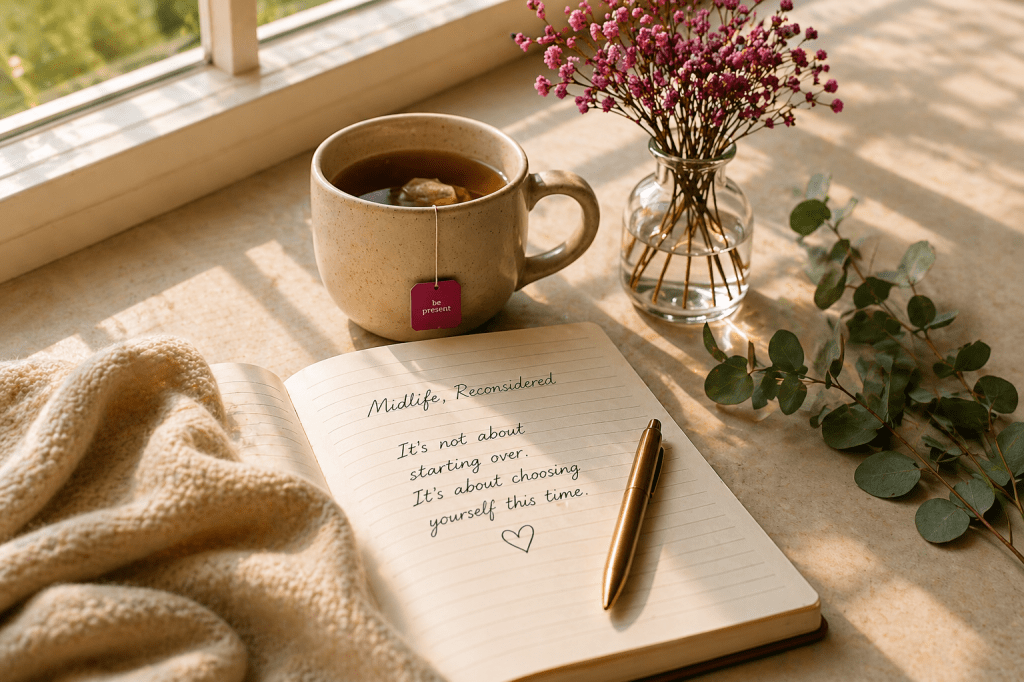
    I started Midlife, Reconsidered because I realized how little space there is for honest conversations about this phase of life.

    There’s plenty of information.

    But much of it feels oversimplified, focused only on symptoms, or disconnected from the broader experience of what it actually feels like to be in your 40s.

    This isn’t just about hormones.

    It’s about:

    • How your body is changing
    • How your identity is evolving
    • How your priorities are shifting

    All at the same time.


    What I Wanted Instead

    I wanted a space that felt:

    • Thoughtful, not reactive
    • Grounded, not trend-driven
    • Honest, without needing to have everything figured out

    A place where it’s okay to say:

    “I don’t fully understand what’s happening yet, but I know something is changing.”


    A Personal and Professional Lens

    This space is shaped by both personal experience and clinical perspective.

    I’ve seen how often women are told:

    • “Everything looks normal”
    • “This is just part of getting older”

    Without a deeper conversation about what’s actually happening.

    I’ve also experienced how confusing that can feel when your body and your internal sense of self are clearly shifting.


    What You’ll Find Here

    This isn’t a space for quick fixes.

    It’s a space for:

    • Understanding what’s changing
    • Re-evaluating what no longer fits
    • Exploring what alignment actually looks like now
    • Reconsidering what we’ve been told about midlife and defining it on our own terms

    Across:

    • Health
    • Identity
    • Career
    • Overall well-being

    If You’re in This Phase Too

    If you’ve been feeling like something is shifting, but haven’t been able to name it, you’re not alone.

    And you’re not imagining it.

    This is a season of change.

    Not sudden. Not always clear. But real.


    Midlife is not something to push through.
    It is not something to survive.
    It is not synonymous with crisis, decline, or running out of time.

    It is a time to reconsider.